
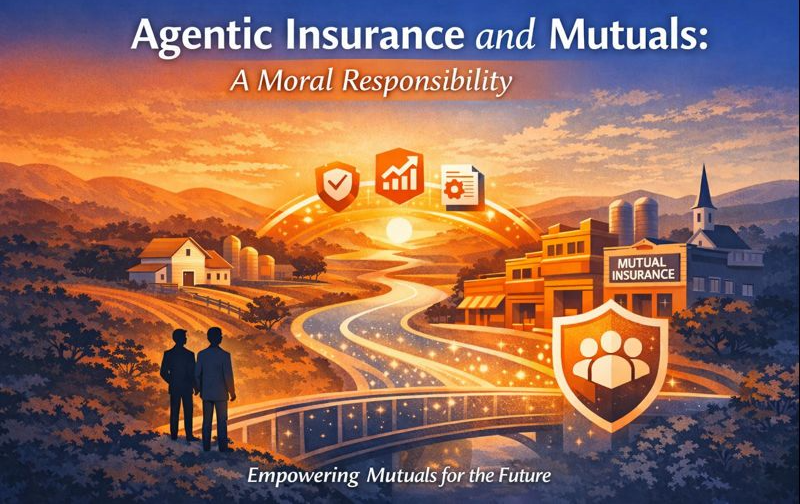
For more than a century, mutual insurance companies have served as one of the quiet pillars of the American economy. Built on the principle of policyholder ownership rather than shareholder profit, mutuals exist to provide continuity, trust, and protection—often in places where insurance markets would otherwise fail. Today, however, mutual insurers face an existential challenge. The rapid acceleration of data-driven underwriting, automation, and AI-driven operations has reshaped competitive expectations across the industry. Bringing Agentic Insurance to mutuals is no longer simply a modernization initiative; it is a moral responsibility. Without it, many mutuals will struggle to compete, to remain independent, and ultimately to fulfill the mission they were created to serve.
Mutual insurers operate under fundamentally different constraints than publicly traded or private equity–backed carriers. They do not have unlimited capital for large-scale technology transformations, nor do they pursue growth at any cost. Their boards prioritize solvency, longevity, and policyholder value. Traditional modernization approaches often force mutuals into an impossible choice: either undertake expensive, disruptive system overhauls that risk independence, or continue operating with manual, labor-intensive processes that steadily erode competitiveness. Agentic Insurance changes this equation. By embedding intelligence directly into underwriting, claims, and operational workflows, agentic systems allow mutuals to modernize incrementally, reduce manual burden, and amplify human expertise rather than replace it. Without these capabilities, mutuals face rising expense ratios, accelerating talent loss as experienced staff retire, and slower response times that agents and members increasingly find unacceptable.
Economic Guardians of Underserved Markets
The stakes extend far beyond individual carriers. Mutual insurance companies play a critical role in the U.S. economy precisely because they serve markets that others cannot—or will not. In rural communities, agricultural regions, and catastrophe-exposed areas, small and mid-sized mutuals are often the only insurers willing to maintain long-term commitments. When insurance disappears, economic activity quickly follows. Homes become uninsurable and therefore unmortgageable, small businesses struggle to operate, and local governments face mounting financial strain. Mutuals help prevent these outcomes by maintaining access to coverage where it matters most.Mutuals also act as stabilizing forces during economic downturns. Free from the pressure of quarterly earnings calls, they are less likely to withdraw capacity abruptly or pursue extreme pricing volatility in stressed cycles. This steady presence helps stabilize housing markets, small business formation, and municipal finance when broader economic conditions are uncertain. In addition, mutual insurers keep capital local. Surplus is returned to policyholders through dividends, lower long-term premiums, or reinvestment in regional operations, rather than being extracted to distant financial markets. This local reinvestment quietly but meaningfully supports economic resilience across large portions of the country.
Preserving Competition and Quality Employment
Beyond capital, mutuals anchor professional employment in small-town America. They provide underwriting, claims, IT, and agency roles in regions that would otherwise lose high-quality white-collar jobs. They also preserve competition in insurance markets by preventing excessive consolidation. Without mutuals, the industry would be more concentrated, premiums would be higher, coverage would be narrower, and consumer choice would diminish.This is where Nativeorange plays a crucial role. Nativeorange was built with mutual insurers in mind, not as an afterthought. Our agentic-first, composable architecture allows mutuals to modernize without surrendering control of their data, governance, or operating model. Single-tenant deployments respect regulatory expectations and policyholder ownership, while outcome-aligned pricing ensures that technology costs scale with real member value rather than arbitrary usage metrics. Nativeorange does not ask mutuals to rip and replace core systems or centralize decision-making outside their organizations. Instead, we help them embed intelligence into existing workflows, preserve institutional knowledge, and operate with the effectiveness of much larger carriers—while remaining fully independent